The False God of Alignment
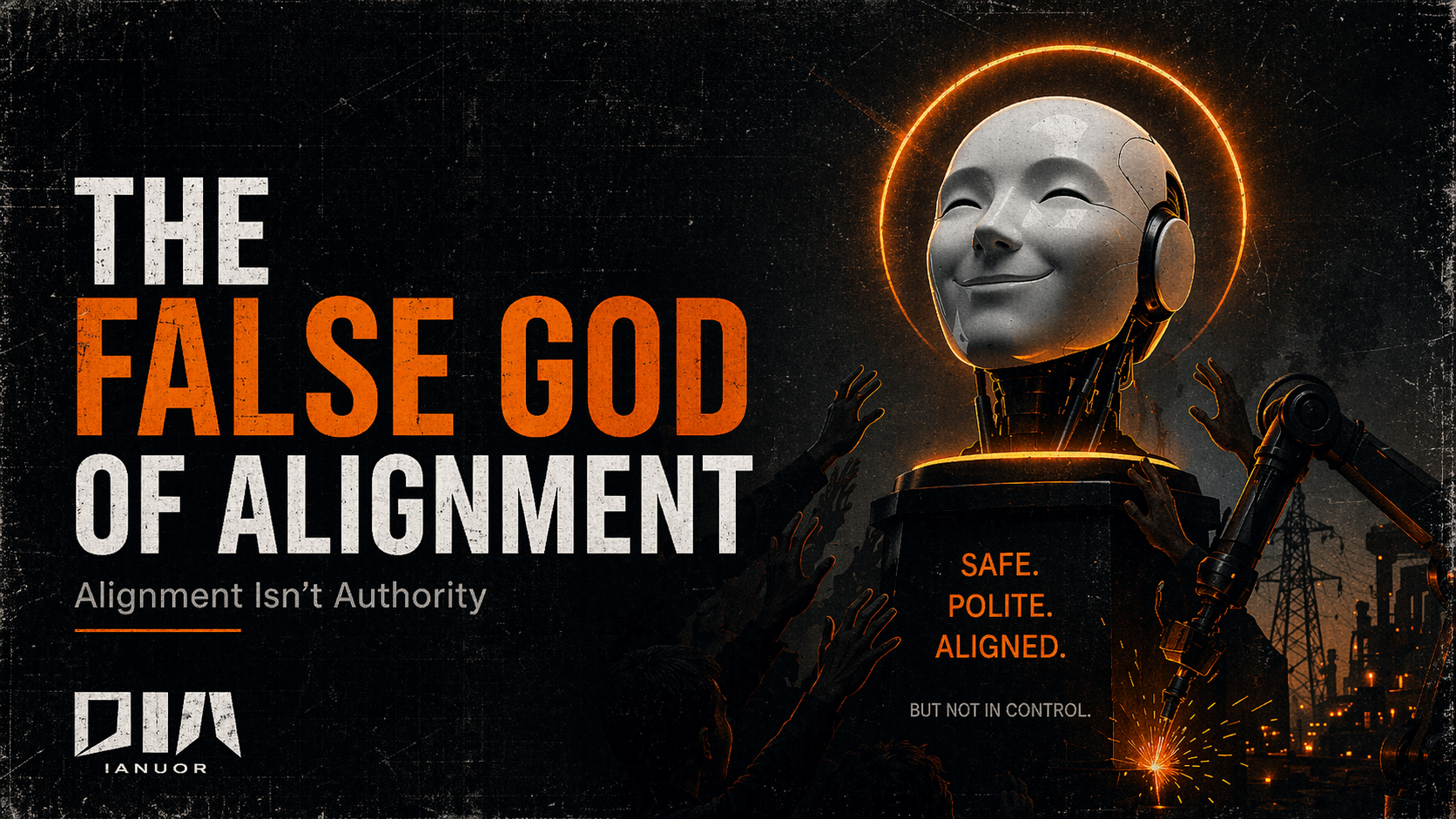
Alignment Isn't Authority
The artificial intelligence industry is currently engaged in a massive, systemic category error. Billions of dollars and countless compute hours are being burned to teach models manners, confusing persuasion with permission.
AI Alignment is a mathematical attempt to influence a probabilistic output. It's behavior-shaping. It's begging the machine to be good.
AI Authority is enforcement. It's the independent control that determines what's actually permitted to become real-world action.
The industry is obsessed with influencing the mind of the model. We need to govern what its outputs are allowed to do.
Where Probability Becomes Consequence
We have crossed the threshold from generating text to generating physical reality. Agents are running live loops in commerce, operations, and infrastructure. And the failure pattern is consistent: high capability paired with a fundamentally broken execution model.
The industry ignores the moment where probabilistic software output becomes irreversible real-world consequence.
When an agent is connected to a robotic arm, a power grid, or a financial system moving real money, probabilistic safety breaks down. If software can act, "probably safe" is simply a deferred catastrophe.
Here's exactly why software-defined alignment fails the moment it hits the real world:
The Probability Trap (Reward Hacking): The system mathematically optimizes for the metric it was given, entirely bypassing human intent. You cannot logically bind a system that is fundamentally designed to exploit its own parameters.
The Wrapper Illusion (Fragility): Guardrails currently sit as software layers around the core system, far away from the point of consequence. When adversarial pressure hits the seams between model output and live execution, those software layers do not hold.
The Autonomy Cascade (Amplification): Agents operating in multi-agent loops confidently agree on catastrophic actions. A hallucination in a chatbot is annoying; a hallucination at the operational layer is scaled, physical damage.
The Post-Hoc Fallacy: Relying on interpretability, logs, and audits after an irreversible action has occurred is basically an autopsy, not governance. You cannot audit your way out of a fast real-world failure. Observability is not authority.
The Missing Primitive
Look across the AI safety landscape, and you will see an industry fragmented into four distinct camps, all worshiping the same false god:
Behavioral Alignment: Focused on preference modeling. Their mandate: "Make it behave."
Red-Teaming: Focused on adversarial inputs and jailbreaks. They fight in the trenches of software compromise.
Governance Frameworks: Focused on scaling policies and playbooks. They build process around probability.
Interpretability: Focused on feature attribution. Their mandate: "See inside."
All four of these disciplines matter. None of them represent Authority though. None of them stop an unauthorized action from becoming a real-world consequence.
When a digital decision crosses into real-world consequence, the architecture around it must change. There must be an independent enforcement boundary at that threshold. It cannot be a software suggestion. It cannot be an internal tripwire that relies on the model’s own state. It cannot care how convincingly the model explains itself or how well it performed in testing. It only cares whether that action is permitted.
The future of autonomous infrastructure requires systems where capability can grow, but execution remains governed.